
A video disappears from social media. An account is suspended. A photograph is shared thousands of times, losing its original context along the way. For human rights investigators working with open-source information, these are everyday challenges that can determine whether information remains useful long after an event has taken place.
Videos, photographs, social media posts and satellite imagery can help document human rights violations, reconstruct events and support accountability efforts. Yet collecting information is only the beginning. The real challenge lies in preserving it, understanding what it can tell us and ensuring it remains accessible and reliable over time.
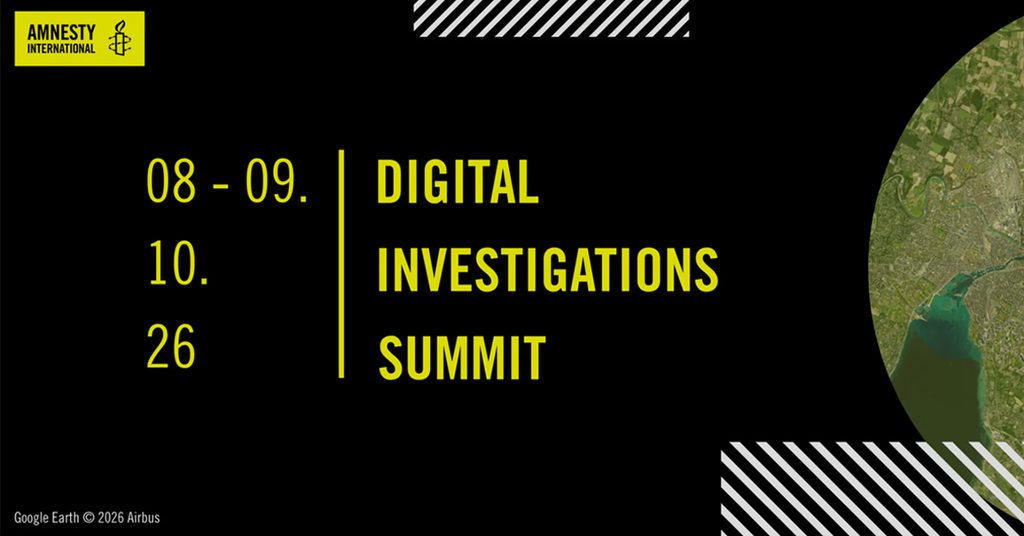
At the Amnesty Digital Investigations Summit in Geneva on 8 and 9 October 2026, practitioners explored the methods, tools and challenges involved in open-source investigations. Drawing on HURIDOCS’ experience in human rights information management, we presented Organising and Storing Open-Source Information: How to Build Evidence Databases, exploring how documentation methodologies, structured data and digital preservation can support investigations over the long term.
Four themes stood out: the importance of provenance and traceability, the need to preserve digital material early, the challenges of verification in the age of AI, and the value of designing information systems around investigators’ needs.
Starting with the purpose, not the technology
When faced with large volumes of digital information, it can be tempting to start by looking for the right tool. But an effective evidence database begins with a different question: what do we need this information to help us understand?
An investigation focused on criminal accountability may have different requirements from one supporting advocacy, journalism or public documentation. These differences shape how information should be collected, organised, preserved and accessed.
Before selecting a platform or building a data model, teams need to establish what they are documenting, how the information will be used and which relationships they need to capture between events, people, locations and sources.
This requires collaboration between investigators, documenters and technical teams. The goal is not to collect every possible data point, but to build a system that supports the investigation’s actual needs and can evolve as new findings emerge.
Connecting the dots without losing sight of the source
Imagine a video circulating online that appears to show an incident involving security forces. Where was it published? When was it collected? Can its location be verified? Does other material support or challenge the initial interpretation? These questions illustrate why organising evidence involves more than storing files. Investigators need to distinguish between the source itself, the information recorded about it and the claims it may support.
The original video is one element. Its metadata and collection history provide another. The interpretation that it depicts a particular event, location or actor is a separate conclusion requiring assessment.
Keeping these elements distinct allows investigators to trace conclusions back to their supporting material, connect multiple sources to an event and identify where uncertainty remains. A well-designed database makes these relationships visible without treating an investigative interpretation as an established fact.
This is particularly important when information may be used in accountability processes, where investigators need to explain not only what they believe happened, but how they reached their conclusions.

Preserving information before it disappears
Online content can be edited or removed, accounts can disappear, and metadata can be lost as files move between platforms. Returning to a source weeks or months later may no longer be possible. A link in a spreadsheet may help locate a source, but it does not guarantee that the underlying material will remain available or unchanged. Preservation therefore needs to begin early, rather than being postponed until information is ready for analysis or sharing.
At the summit, HURIDOCS presented on Preserve, its tool and browser extension that captures digital content and archives them with accompanying key metadata. Preserve’s current capture workflow, which includes server-side retrieval of online content, SHA-512 hashing and third-party timestamping through FreeTSA. Material can be captured in formats including HTML, plain text, PDF, screenshots and video formats. These mechanisms serve complementary purposes: capturing content creates a record of what was available at a particular moment; hashing helps identify whether a file has changed; and timestamping helps establish when a digital record existed.
However, preservation is not verification. Capturing a video does not establish that it is authentic or that it depicts the event it claims to show. Preservation ensures that material remains available for scrutiny, providing a foundation for further investigation as new information emerges.
Making traceability part of the process
Knowing that a file has been preserved is important. Knowing where it came from, how it was collected and what happened to it afterwards is equally essential.
Provenance and chain of custody help maintain a traceable history of a digital item and its handling. This means recording who collected the material, when and how it was obtained, and which preservation or processing steps were applied. Without these records, reconstructing an item’s history can be difficult. Links disappear, team members move on, and the reasoning behind earlier decisions may be lost.
Traceability should not be an administrative task left until the end. Integrating it into everyday workflows helps investigators explain their conclusions and demonstrate how findings relate to the underlying material.
Investigating critically in the age of AI
AI-generated and AI-manipulated content presents additional challenges for open-source investigations. Determining whether material is authentic, altered or generated can be difficult, particularly when it has circulated widely and lost its original metadata.
Technical tools, including watermark detectors, can contribute to verification, but their results are rarely conclusive. The absence of a watermark, for example, does not establish authenticity, as markers may be lost when content is copied or republished.
Investigators need to combine different methods, including reverse-image searches, contextual analysis and corroboration with independent sources.
AI-based image enhancement presents a particular risk in criminal investigations: processing can introduce details that were not present in the original image. If interpreted as evidence, these details may create a misleading impression of what the source actually shows.
Preserving originals, documenting processing methods and acknowledging analytical limitations are therefore essential. Technology can support investigative work, but it cannot replace critical thinking, corroboration or transparent methods.
From collecting information to supporting accountability
Every photograph, video or social media post collected during an investigation represents a potential piece of a much larger story. But finding these pieces is only the beginning. Their value depends on whether they can be preserved, connected, understood and used to help establish what happened.
The Amnesty Digital Investigations Summit reinforced an important lesson: information does not become meaningful evidence simply because it has been collected. It requires a process that preserves its origins, documents how it has been handled, connects it to other sources and makes the reasoning behind investigative conclusions transparent.
This is where information management becomes an essential part of human rights work. Behind every investigation lies the often-invisible work of organising records, establishing relationships, documenting sources and ensuring that information remains accessible over time. When done well, this work allows investigators to move beyond isolated pieces of information and build a more complete understanding of events.
At HURIDOCS, we see technology as part of this broader process. Through Uwazi and its adjacent methodologies, we help human rights organisations and practitioners organise information and connect records, events, actors and cases. Through Preserve, we aim to support the capture of online material and the documentation of its integrity and provenance. Both tools reflect a shared principle: information systems should support investigative practice, helping people work with complex information without losing the context that gives it meaning and evidentiary value.

The conversations in Geneva also reminded us that these systems cannot be developed in isolation. Investigators’ needs evolve, technologies change, and new challenges emerge. The rise of AI-generated content, the fragility of online sources and the growing scale of digital investigations all reinforce the need for continued collaboration between practitioners and the teams developing the tools they use.
Ultimately, the goal is not simply to collect more information or build increasingly sophisticated databases. It is to ensure that the information gathered today can still be understood, scrutinised and used tomorrow, even as investigations evolve and the people working on them change.
Preserving information is not just about keeping a record of the past. It is about helping ensure that the information needed to establish the truth remains available when it matters most.
The HURIDOCS team would like to thank Amnesty International for inviting us to the Digital Investigations Summit and for creating a space for such valuable exchanges. If you would like to explore these ideas further or discuss how HURIDOCS’ tools and methodologies could support your work, we would love to hear from you.