Imagine we could take the attacks we know about and use them to see the ones we know nothing about. Attacks that happened in silence. Never reported. Never recorded. Never counted.
Between January 2024 and October 2026, El Obse (the Observatory of attacks against human rights defenders and journalists in Chiapas, Mexico) documented more than 300 attacks against almost 200 human rights defenders in the state. Six of them were killings. Behind each record is at least one organisation that was nearby, a person who chose to tell what happened, and a team that verified it.
The observatory itself acknowledges that these figures are a sample, and far from the full extent of the violence that strikes civil society in Chiapas. Many attacks go undocumented, and there are no official figures specifically on attacks against human rights defenders in the state.
This raises a fundamental problem: documented counts reflect both the violence itself and the capacity to document it. A region with no recorded cases may be a region without violence, or a region where no one is documenting. Counts alone cannot tell us what is happening.
That is why El Obse will explore setting up a system to estimate, each year, how many human rights defenders in the state suffer serious attacks, including those that no organisation manages to record. The observatory will do so with statistical support from the Human Rights Data Analysis Group (HRDAG) and technological support from HURIDOCS.
What is multiple systems estimation?
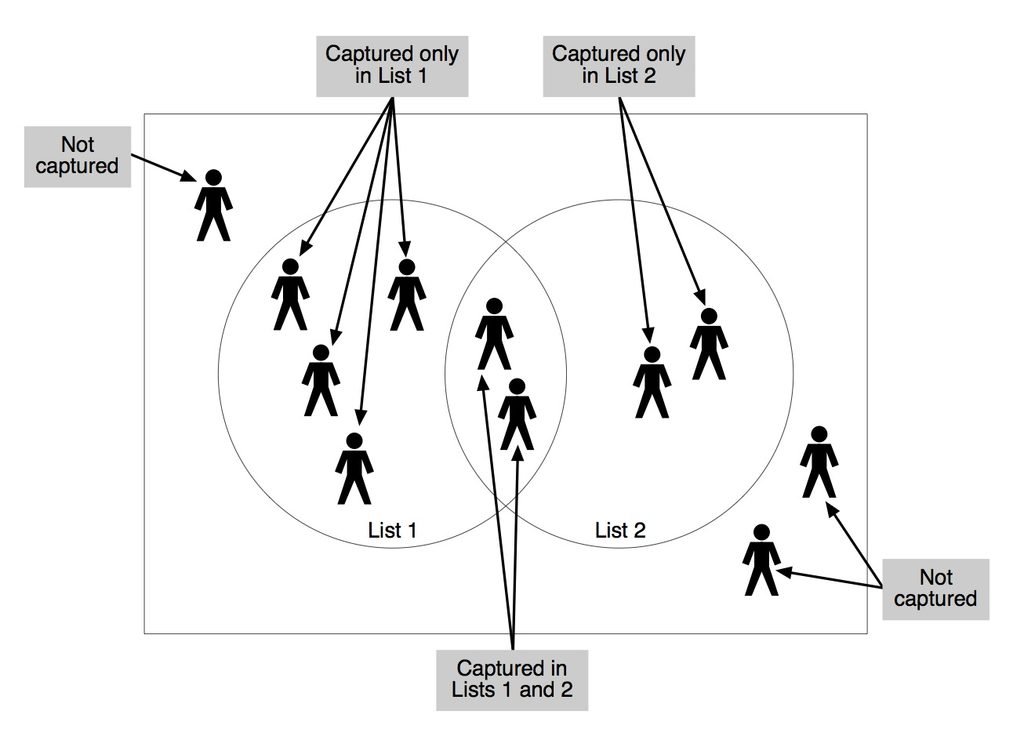
Multiple systems estimation (MSE) is a statistical method designed to answer this kind of question. The method starts from several incomplete lists of the same events, compiled by different sources. By comparing them, it identifies the cases that appear on more than one list. That overlap makes it possible to estimate how many cases do not appear on any list. The logic is intuitive: if the lists overlap a great deal, together they probably capture almost everything that happened; if they overlap only a little, much probably remains unrecorded.
HRDAG has applied this method since the 1990s in contexts of serious human rights violations, such as Guatemala, Peru, Kosovo, Syria and Colombia. The closest precedent is its estimate of killings of social leaders in Colombia, produced with Dejusticia using the records of several organisations.
“In human rights work, so often our data sources, however incomplete, were painstakingly collected and maintained over years. Those stewarding the data often faced great difficulty and personal risk to obtain the stories and reports used in our analyses. One way we can honour the labour that went into the production of human rights data is to responsibly use it in the pursuit of truth. Multiple systems estimation is a powerful tool towards that end.”
– Maria Gargiulo, 2026, HRDAG
All is Not Lost with Incomplete Datasets
What the project will do
The organisations behind El Obse are exploring a pilot project that would be rolled out in phases, with each phase depending on the results of the previous one. Dates are not fixed, as they depend on resources and on agreements with the sources, but El Obse aims to publish a first estimate in 2028.
The project involves four phases:
- Identify partner sources
El Obse will identify organisations and networks that document attacks in Chiapas and propose a data-sharing agreement to them, based on equitable and non-extractive principles. - Link the records
A working group will identify which records from different sources refer to the same person and the same case. Digital tools will suggest matches; but people will always make the final decision. - Estimate
Estimates will be calculated by year and by victim profile, and HRDAG will validate the reliability of each one before publication. - Share the results
The communities and organisations that contribute data will receive the results through written reports and in-person meetings.
What it will be used for
A validated estimate will give El Obse and its member organisations:
- A solid baseline to counter official narratives that downplay the human rights crisis in Chiapas.
- Evidence to share with human rights mechanisms of the United Nations and the Inter-American System, as well as withMexican civil society.
- A reference point for monitoring protection measures for human rights defenders and journalists.
“El Obse represents a collective effort to build a response to the growing violence in Chiapas. It stems from the urgent need to make visible the attacks against human rights defenders, in a context where silence and impunity prevail.”
– SiPaz, 2025, El Obse
Documentar para visibilizar: El Obse de Chiapas frente a la violencia contra personas defensoras.
The role of HRDAG and HURIDOCS
El Obse, powered by Uwazi, HURIDOCS’ open-source platform, already hosts the documentation collections of more than 20 partner organisations. For this project, HURIDOCS will provide the infrastructure that supports the process from start to finish:
- A dedicated and private Uwazi instance, hosted on HURIDOCS servers, bringing together the records from all sources and the results of the linkage.
- Python tools to import and validate each source’s data, manage record linkage across sources and prepare the data for analysis.
- Digital security throughout the process.
HRDAG joins the team to support and oversee the application of the statistical methods, with models run in R, to ensure the reliability of the results. HURIDOCS is very excited about and grateful for HRDAG’s involvement in this initiative, which is essential to guarantee methodological rigour and produce validated results.
The project also marks a new use for Uwazi: the platform is already used for documentation, and will now also serve as a basis for statistical analysis.
“Technology can help documenters collect information offline and securely, preserve provenance, structure and analyse information, and connect information held across different systems. Increasingly, it may also help people navigate accumulated knowledge and find relevant methodologies, standards and experience when they need them.”
– Danna Ingleton, 2026, HURIDOCS
What wartime documentation demands of technology: Lessons from Sudan
Protecting data, protecting people
Bringing together the names of human rights defenders from several sources in one place calls for the strongest safeguards. Access to the database will be restricted to the working group. Once record linkage is complete, the statistical models will work without names: they only need to know which sources each person appears in. Every agreement with a source will also explicitly include consent for this use of the data and a commitment to strict confidentiality.
The project is also honest about its limits. An estimate is a range, not an exact figure, and it will be communicated as such. If the available data are not sufficient for a robust estimate, the project will still deliver a useful result: a report on each source’s coverage and the overlap between sources.
The quality of the estimate will depend on the sources that take part. El Obse invites organisations and networks that document attacks against human rights defenders and journalists in Chiapas to join the project as partner sources.
Interested in supporting or joining this project? Reach out to elobsedefchiapas@proton.me
For more information about the observatory, visit elobse.org.
For more information about the methodology, visit hrdag.org.