Lee este artículo en Español.
Enjoy the article as a narrated audio reading by Lucía:
From a very young age, I have been aware that my purpose in life has always been to defend human dignity, whatever job, role or country I happened to be in. It is vital to focus on the values that frame our daily lives and shape the decisions and choices we make, so that we can develop critical and strategic thinking that is fair, conscious and able to integrate past, present and future. In this sense, HURIDOCS’ mission resonates deeply with me: the work we do to recover and safeguard the memory of violations, to support documentation processes for reparation and transitional justice, and to contribute to advocacy and awareness-raising.
Professional journey
I began working in international cooperation in 2007 on a co-development project between Saraguro (Ecuador) and Murcia (Spain) for the Valencian NGO ACSUD Las Segovias, which later became Perifèries. In 2010, I moved to Ecuador to manage the portfolio of projects funded by the Valencian regional government, overseeing more than 25 initiatives across the country. I went on to spend ten years in Ecuador working with international organisations, Spanish NGOs, national and local public institutions, grassroots organisations and social enterprises.
Later, I travelled to India to deepen my understanding of non-violence (ahimsa). I lived for a time in a Jain temple and visited development initiatives across the country – focusing on gender, agriculture, children and livestock – all rooted in this ancient philosophy that inspired Gandhian thought. I then went to Nepal as a volunteer, supporting capacity-building and advocacy projects for women and families who had survived gender-based violence and human trafficking.
After nearly twelve consecutive years abroad, I returned to Spain, where I worked as a volunteer coordinator for a bank. HURIDOCS later hired me to carry out a consultancy on the technological needs of human rights defenders, and following that consultancy, I was offered the role of Programme Manager.
My arrival at HURIDOCS
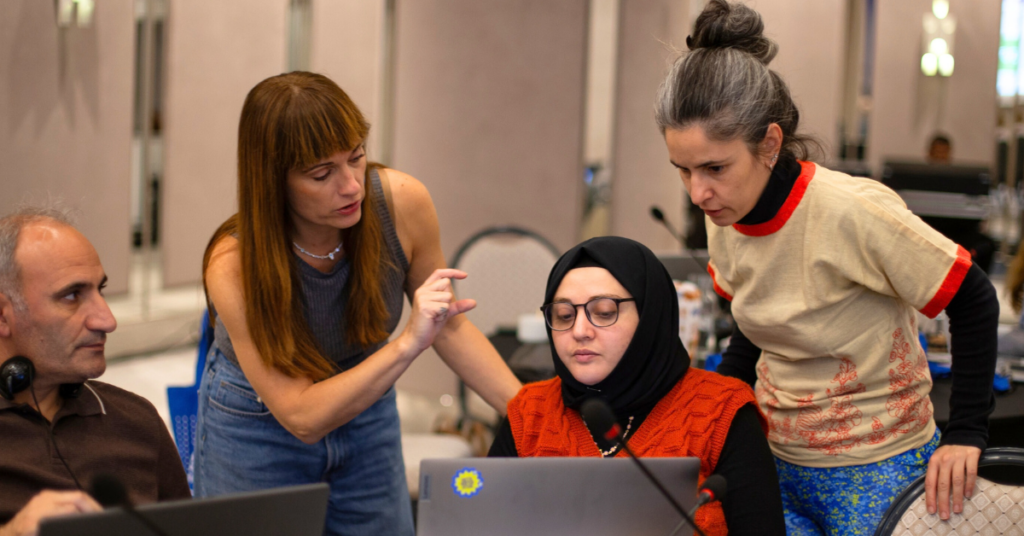
My first project with the organisation was with IRI in Nicaragua. It was my first project at HURIDOCS and the first time in my career that I was working at the intersection of human rights documentation and technology, which was a significant challenge for me. I felt warmly welcomed by the team and very well mentored and guided.
The colleagues who supported me at that time marked a turning point in my professional journey within HURIDOCS. It increased a deep understanding of the importance of expert accompaniment for grassroots organisations in their tireless efforts to document violations in the most appropriate and sustainable way, violations of which they are often themselves the subjects. I am fortunate to continue sharing daily work with them and to keep learning each time I see them engage with a partner or contribute in a team meeting.
What does working at HURIDOCS mean to me?
“Working at HURIDOCS is very much like being a professional chess player. Whatever a partner brings to us, we need the ability to understand what to do with that information and to think several moves ahead.“
There is tremendous creativity rooted in the wide, diverse personal and professional experiences of everyone on the team. Bringing our minds together and being the least knowledgeable person in the room is incredibly stimulating and motivates me every day.
When you truly understand and feel, in every cell of your body, that the people you are walking alongside professionally have only the best intentions and share your understanding of dignity and justice, even if they express it differently, how could you not feel motivated to become better and better? How could you not want to rise to the level of such an extraordinary team, and of the remarkable work, honesty and courage of the organisations we have the immense privilege to accompany?
Beyond technical competencies, there is another essential quality: the ability to navigate and immerse oneself in culturally hyper-diverse contexts. This environment requires mental flexibility, adaptability and responsiveness, sensitivity and active listening, as well as a strong capacity for teamwork.
We occupy a bridging role. We must understand both the needs and possibilities of the teams that approach us to work on documentation projects and the capacities and priorities of our own team. It is about reconciling needs with realistic and scalable possibilities.
At the same time, we operate within a constantly evolving global technological landscape that does not always align with the technological realities and needs of our partners. As a technological ally as well, it is important to help organisations understand, in a holistic and specific way, the risks and opportunities presented by today’s technological advances – advances that will shape not only tomorrow, but the next ten years.
Final reflections
HURIDOCS allows me to continually examine my own biases and forms of violence. The world is violent and biased because each of us carries something within us – something of Hitler, of Franco, of Pasha, of Pol Pot. If we were all Tibetan monks, perhaps things would be different, though perhaps not even then. We have to acknowledge it, speak about it and return to that uncomfortable truth. I want to unlearn the world that was handed down to me by facing it directly. My work allows me to do that. I allow myself to do it.
“If there were no conflicts or inequalities, there would be no work. Full stop. I carry that awareness with me every day.”
One of the most complex aspects of my work – and I believe of anyone working in development, humanitarian aid or human rights – is reconciling the fact that our work exists because of the very realities we are trying to change. If there were no conflicts or inequalities, there would be no work. Full stop. I carry that awareness with me every day. I try to work with full consciousness, understanding that there is profound transformative power in how we show up with others: the values we bring to the table, our communication styles, and the language we choose. These may seem more subtle, less forceful elements, but personally, I believe they are what allow us to build genuine relationships of trust from which different kinds of realities can begin to emerge. Or at least, that is what I hope.